Music Matters XXXI: Can music affect climate justice? – A Discussion with Dr. Ellen Waterman 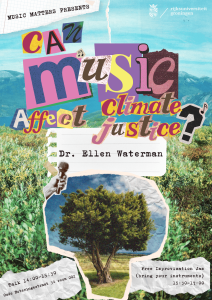
Sonic Worlding: co-creation, equitable participation, and climate justice is a five-year artistic research project (SSHRC, 2026-32) led by Dr. Ellen Waterman at Carleton University in Ottawa, Canada. The Sonic Worlding team includes artist researchers and climate activists who are collaborating with d/Deaf, disabled, and neurodivergent musicians to explore what it’s like to live during this time of climate crisis and to imagine more livable futures. Their practice/artistic-based research methodologies involve making music, sound art, films, and podcasts and reflect on how Disability, neurodiversity, and d/Deaf communities are some of the most impacted by climate disruption, but their perspectives are all too often ignored in climate change policy (UNHRC 2020, Jodoin et al. 2020). These communities, however, have expertise in adaptation and resilience that can make a valuable contribution to our ability to imagine liveable futures. This interactive session will discuss and demonstrate how through storytelling and co-listening, participatory sonic arts can be a powerful vehicle for climate justice artivism and offer an socially impactful story. It will explore the question: How do we move from art making to climate action, and how can we tell if our work is having an impact? Can music really affect climate justice?
Music Matters XXX: Phantom Bands- A Discussion with Dr. Benjamin Piekut
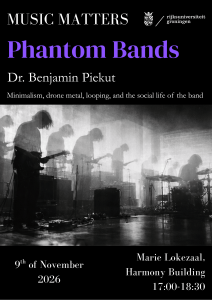
Unlike many other postwar musical avant-gardes, minimalism developed a significant extension in the field of popular culture, most notably in drone metal in the twenty-first century. This development could be anticipated to some extent, given the inspiration and musical techniques that the early minimalists found in Black and nonwestern musics, and the importance they placed on lateral relations of authorship that departed from elite musical culture’s lionization of the composer-genius. But in the half-century of minimalism’s gradual unfolding, the ecological niche it once occupied has undergone its own profound transformations. On the one hand, the vernacular mode of production that once distinguished the popular field from fine art has been fully adopted by participants in the latter. On the other hand, popular music aesthetics developed a stratification of taste around typically masculinist repertoires like rock. For these reasons, the meaning of minimalism’s crossing into popular culture is inscrutable and even contradictory. Furthermore, the social relations of the band, which Patrick Nickleson has identified as so important to minimalism’s critique of western art music, were quickly incorporated into live music technologies that enable a single performer, on stage or in their bedroom, to replace the give-and-take of convivial musicality with its simulation in the form of loop stations. Examining examples from Terry Riley, Earth, Kali Malone, Steven O’Malley, and Justin Bieber, this talk by Benjamin Piekut ( Cornell University, Deparment of Music) tries to follow the reversals and extensions of minimalism’s crossover into the popular by continually inquiring into its production of the social.
Music Matters XIX: Our City’s Carillons – A Discussion about Bells, Groningen, and Pop Music
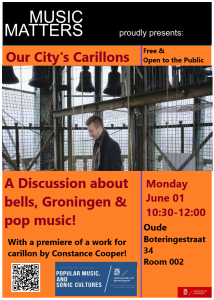 You hear them a few times every hour, but how much do you know about the wonderful carillons in Groningen? To learn more join us June 01 for a discussion about the Martini carillon, the University of Groningen carillon, the two musicians who currently play them (who take requests!), and the different array of compositions we hear on them (from popular music to traditional tunes!). During the session, we’ll all go out in the streets together to hear a piece composed by American composer Constance Cooper. Constance will be present, so we’ll also hear from the composer about her work. Join us! The event is free, open to the public and will take place Monday June 01, 10:30-12:00 in Oude Boteringestraat 34 room 002.
Music Matters XLVII: A Conversation with Iguana Death Cult
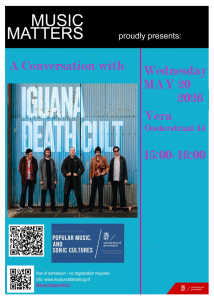 On Wednesday May 20th 2026 (15:00-16:00) at Vera Groningen we’ll conduct a public interview with one of The Netherlands’ most exciting bands, Iguana Death Cult. We’ll discuss songwriting, style, live performance, the development of their career, global music scenes, and balancing domestic and international touring. This event is the 47th event in the Music Matters at University of Groningen series and it is free and open to the public.
.
University of Groningen Hosts the 2026 European Hip-Hop Studies Conference
Things done changed. Hip Hop studies’ foundation took place more than 30 years ago, with core writings such as Tricia Rose’s Black Noise setting the Blueprint and establishing debates that continue to this day. Since then we have seen great change: 2Pac and The Notorious B.I.G passed away in the mid-1990s, rap music’s sound palate has continued to expand (e.g., through crunk, trap into drill), with the genre in its various forms dominating the airwaves worldwide, and altering the shape of popular music writ large. At the same time, many of the structural dynamics that were at the root of Hip Hop’s inception continue to foster inequities, with systemic racism, sexism, and global capitalism wreaking havoc across the world.
The conference will take place in the Groninger Museum, during a major Hip Hop exhibition at the museum entitled Hip-Hop Is taking place between December 2025 and May 2026. See https://www.groningermuseum.nl/en/press/nieuwe-tentoonstelling-hip-hop-is-in-groninger-museum for more information on the exhibition and https://europeanhiphopstudiesnetwork.wordpress.com/network-meetings/ehhsn-9-0-2026-meeting-groningen-the-netherlands/ for more information on the conference.

Music and Culture Talks (RUG x ESNS) #2 – Sherlock Telgt in discussion with Skits of Dope D.O.D.
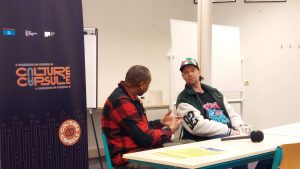
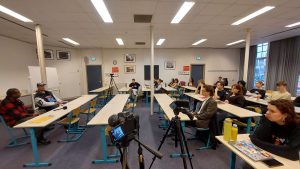
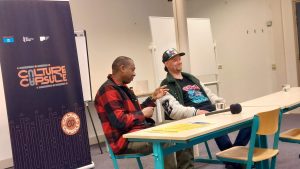
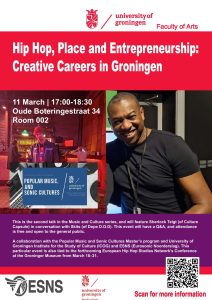 Wednesday March 11 2026 we hosted a conversation between “Godfather of Groningen Hip-Hop” Sherlock Telgt (of Culture Capsule) and Skits of Groningen based international Hip-Hop group Dope D.O.D.
The discussion focused on hip-hop in the Netherlands, the entrepreneurial means necessary to ensure longevity as a musician today, and the importance of place – with Groningen remaining vital to their practice,
Dope D.O.D recently launched their new album Multiverse! Check it out!
A few snapshots of the event:
Music Matters XLVI (21 & 22/01/2026) Two Talks by Martin Stokes
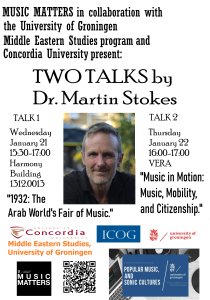
In January we co-hosted two public talks by ethnomusicologist Dr. Martin Stokes: An on campus talk entitled “1932: The Arab World’s Fair of Music” and a talk at Vera (Oosterstraat 44) entitled “Music in Motion: Music, Mobility and Citizenship.” This second talk was connected with a concert by the Daryn Esemble that took place at Vera in the evening.
For more details see: https://www.vera-groningen.nl/events/music-in-motion-2026/?lang=en
Music & Culture Talks #1 (15/01/2026)
Starting in 2026, we are partnering with Eurosonic to present a new series of talks at the intersections of Eurosonic’s mission to support the international music ecosystem and emerging European artists and research questions of interest to scholars and students in the Popular Music and Sonic Cultures Master’s program. Sponsored by ICOG, the Groningen Research Centre for the Study of Culture, the series will feature discussions with artists, music industry figures, and scholars. The first event took place during Eurosonic 2026 and consisted of two hour-long panel discussions:
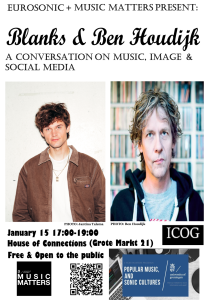
In the first part of the program featured Groningen’s very own Blanks, Irish artist SexyTadgh, and music photographer Ben Houdijk. We discussed crafting artist identities and generating audience engagement through photography and innovative online artmaking and social media content production. It was a valuable discussion for developing artists, influencers, and students interested in performance, image, social media and identity.
See: https://esns.nl/nl/conference/panels/esns-talks-crafting-musical-identities/
Here’s a shot from the event:
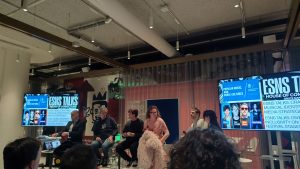
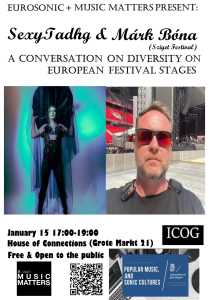
Then in part two of the program, we spoke with Sziget (Hungary) festival booker Márk Bóna and artist and activist Sexytadgh and discussed perspectives on how to cultivate diversity on festival stages and the differing needs of distinct regions in Europe. We focused specifically on the impact of queer performance and the programming of diverse lineups with a specific focus on Hungary and Romania. MA students from the Music Industries and Digital Culture course presented the research they completed as part of the Diversity, Equity, Inclusion, Belonging and Accessibility research project the Popular Music and Sonic Cultures MA program maintains in collaboration with Eurosonic Noorderslag. For more of this research see: https://www.rug.nl/society-business/science-shops/taal-cultuur-en-communicatie/projecten/2-lopende-projecten/inclusivity-in-the-live-music-industry/
See also: https://esns.nl/nl/conference/panels/esns-talks-diversity-and-inclusivity/
Music Matters XLII (31/10/2025) Music and the Resilience of New Orleans
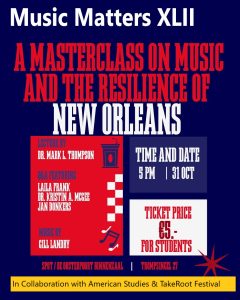
The Music Matters at University of Groningen Lecture & Performance Series returns on October 31st with a lecture, performance, and panel discussion on the music cultures of New Orleans.
Louisiana based singer-songwriter Gill Landry (former member of the band Old Crow Medicine Show, see www.gilllandrymusic.com/) perform and engage in discussion with NPO Radio 1 journalist Laila Frank, pop culture journalist Jan Donkers, and Arts Culture and Media professor and musicologist Dr. Kristin McGee. There will also be a short lecture on New Orleans music by American Studies professor Dr. Mark Thompson.
This event is a collaboration with the Take Root Festival https://www.spotgroningen.nl/events/takeroot/ and the American Studies program at University of Groningen.
All are welcome to join. Tickets are 5 EUR and are available at:
www.spotgroningen.nl/programma/american-studies-presents-takeroot-talks/